Peptide Testing: Hplc & Mass Spec Pureness Guide Peak
@caidenjuvd775
October 2, 2026 · 3 min read
Verified > 99% Lab-grade Peptides
Facing Peptide Evaluation Difficulties? Boc Sciences Can Help!
- We select approaches according to peptide size, hydrophobicity, charge account, and alteration status instead of forcing every sample into one template.
- If covering isn't perfectly effective, an uncoupled chain can continue to elongate in subsequent actions, creating a peptide that's only one deposit short of the target.
- Our process is created to move from sample context evaluation to interpretable peptide data with marginal analytical uncertainty.
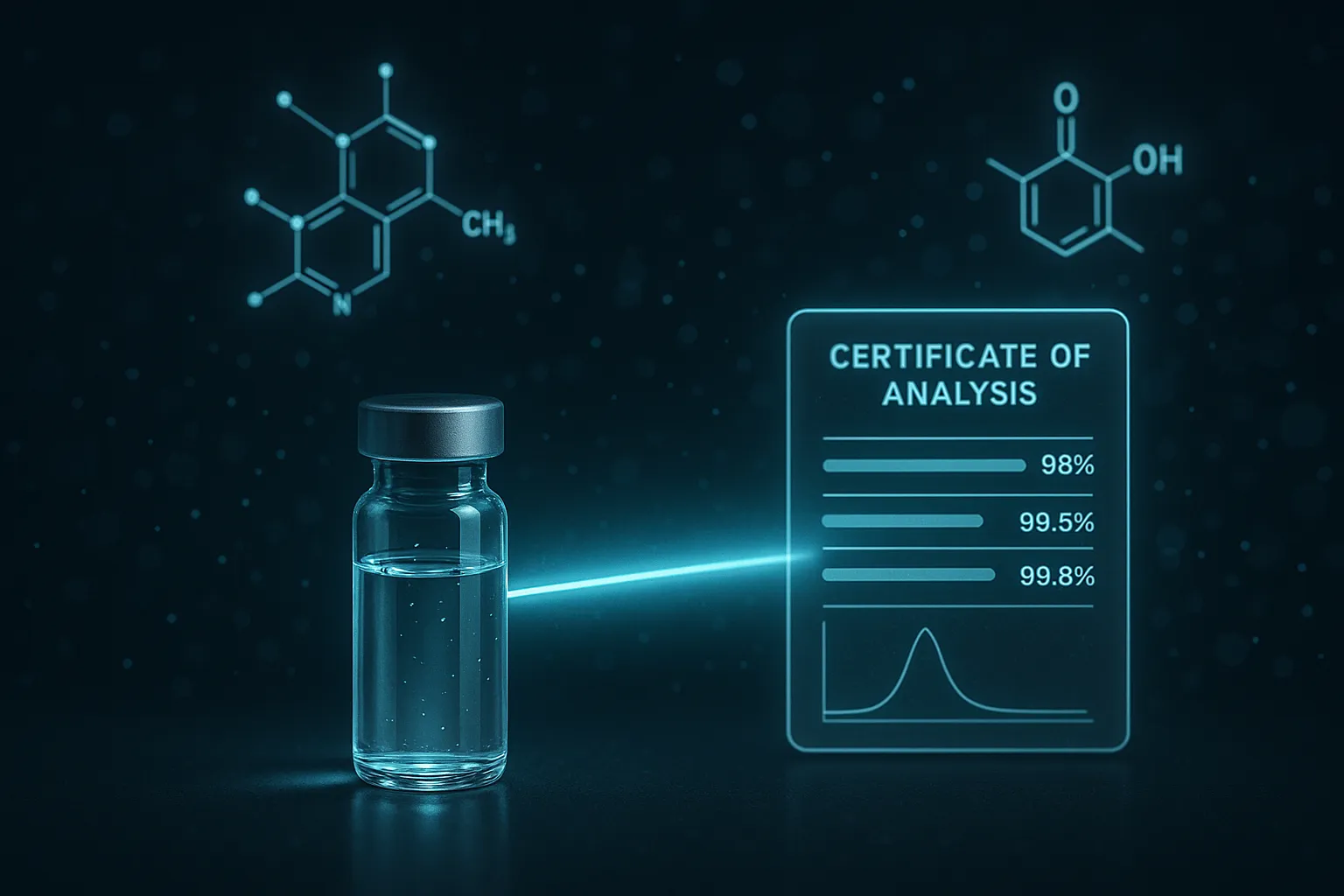
- If the COA details "total pollutants", that matches the purity figure (e.g., 98% purity implies 2% complete impurities).
High pureness is preferable because also little pollutants may interfere with speculative outcomes or analyses. This post will break down how peptide purity is determined, why it stands out from peptide identity, what the common pureness levels (95%, 98%, 99%) represent, and what "research-grade" implies in practice for peptide reagents. Numerous peptide programs run into logical uncertainty prior to they fail medically. We use innovative reverse-phase HPLC to establish the pureness of client peptide examples.

Often Asked Inquiries (Faqs) Regarding Lab Validation In Peptide Research Study
A single generic chromatographic approach is usually not nearly enough for peptides that are hydrophobic, extremely basic, very closely related in turn, or partially cleansed. We offer HPLC and UPLC purity evaluation workflows that concentrate on useful splitting up instead of just generating a portion. We create logical https://angelocbca428.northcrestbrief.com/posts/individuals-are-transforming-themselves-right-into-guinea-pig-the-injectable-peptides-craze-sweeping-the-us-well-really operations around the sample kind, series functions, adjustment profile, and decision context. Projects might include crude intermediates, detoxified peptides, saved great deals, client-supplied products, or materials created through our custom peptide synthesis platform.The most rigorous quality, entailing careful HPLC purification-- often numerous rounds-- and rigorous QC. Needed for measurable researches, structural biology, in vivo study designs, and any kind of application where even percentages of pollutant might influence results. This is the quality where the cost increases most greatly, since achieving that last 1-- 3% of purity needs disposing of a significant portion of the synthesized product. A removal peptide missing a single deposit could still bind to the very same receptor, yet with different fondness or selectivity. In concentration-response experiments, these impurities can change curves, squash plateaus, or introduce biphasic behavior that obscures truth task of the target substance. The isoelectric factor (specialty) is a vital specification for recognizing peptide solubility and habits in numerous atmospheres.
The table below web links common job objectives to sensible analytical panels and the kind of choices they aid support. Asparagine and glutamine deposits can undergo deamidation, altering the peptide's Research Supplier cost and hydrophobicity. Deamidation is one reason storage space problems matter, especially after a peptide has actually been reconstituted. Every product we bring is lab-tested and confirmed by third-party companions, so researchers recognize specifically what they're dealing with. Peptides including methionine or cysteine residues are susceptible to oxidation. Methionine can be oxidized to methionine sulfoxide; cysteine can create unwanted disulfide bonds or be oxidized to sulfinic or sulfonic acid by-products.